








-
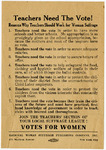
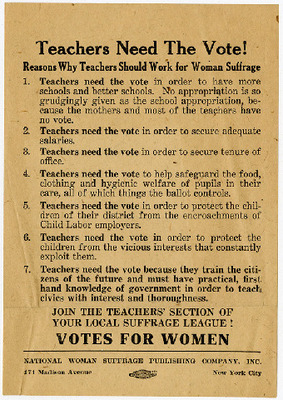
Teachers Need The Vote! Reasons Why Teachers Should Work for Woman Suffrage
National Woman Suffrage Association (NWSA) handbill listing the reasons why women teachers need the vote. Reasons given include: to improve schools, to secure adequate salaries, to secure tenure of office, to safeguard food, clothing, and hygienic welfare for students, to protect children from labor exploitation, to protect children from other exploitation, and to " train the citizens of the future and must have practical, first hand knowledge of government in order to teach civics with interest and thoroughness." It encourages readers to join the Teacher's Section of their local suffrage league.
Women's Suffrage: The Movement, Social Welfare History Project -
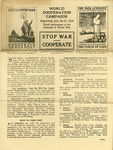
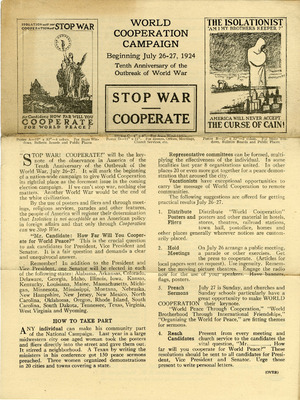
World Cooperation Campaign, 1924
National Council for Prevention of War (U.S.)
This campaign flyer, dating to July 1924, launches a nationwide observance of the Tenth Anniversary of the Outbreak of World War I with the keynote message, "STOP WAR! COOPERATE! ISOLATION WILL NOT STOP WAR!" This document was published by the National Council for Prevention of War (NCPW), an organization that, under the direction of Frederick Libby, coordinated various high-profile anti-war campaigns. Published during the presidential election cycle, the leaflet explicitly casts international cooperation as "the foremost issue" and demands that the public hold political candidates accountable with the question, "Mr. Candidate: How Far Will You Cooperate for World Peace?"
Excerpts:
"'STOP WAR! COOPERATE!' will be the keynote of the observance in America of the Tenth Anniversary of the Outbreak of the World War, July 26-27. It will mark the beginning of a nation-wide campaign to give World Cooperation its rightful place as the foremost issue in the coming election campaign. If we can't stop war, nothing else matters. Another World War would be the end of the white civilization.By the use of posters and fliers and through meetings, religious services, parades and other features, the people of America will register their determination that Isolation is not acceptable as an American policy in foreighn affairs and that only through Cooperation can we Stop War."
-
![We Must End War, [1928] by National Council for Prevention of War (U.S.)](https://scholarscompass.vcu.edu/clark_docs/1002/thumbnail.jpg "We Must End War, [1928] by National Council for Prevention of War (U.S.)")
We Must End War, [1928]
National Council for Prevention of War (U.S.)
Pamphlet urging public and legislative support for the ratification of the 1928 Paris Peace Pact (Kellogg-Briand Pact), an international agreement to renounce war as a means of resolving conflicts. The document features quotations from prominent American figures, including Cardinal Hayes, President Calvin Coolidge, Major-General John F. O’Ryan, Senator William E. Borah, and Rev. S. Parkes Cadman, emphasizing moral, civic, and political arguments against war. Issued by the National Council for Prevention of War.
-
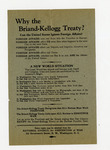
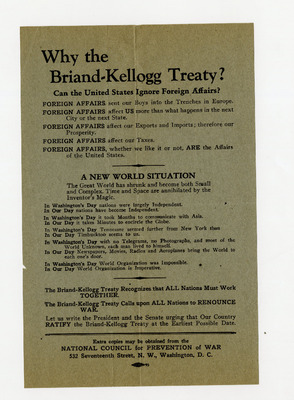
Why the Briand-Kellogg Treaty? Can the United States Ignore Foreign Affairs?, 1928
National Council for Prevention of War (U.S.)
Pamphlet promoting public awareness and support for U.S. ratification of the 1928 Briand-Kellogg Treaty (Paris Peace Pact), which sought to outlaw war as an instrument of national policy. It urges citizens to write to the President and U.S. Senators advocating for ratification of the treaty.
Excepts:
"Can the United States Ignore Foreign Affairs?FOREIGN AFFAIRS sent our Boys into the Trenches in Europe...
FOREIGN AFFAIRS affect our Taxes.
FOREIGN AFFAIRS, whether we like it or not, ARE the Affairs of the United States."
"A NEW WORLD SITUATION
The Great World has shrunk and become both Small and Complex. Time and Space are annihilated by the Inventor's Magic"...."In Our Day Newspapers, Movies, Radios and Aeroplanes bring the World to each one's door." -
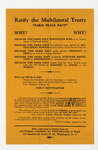
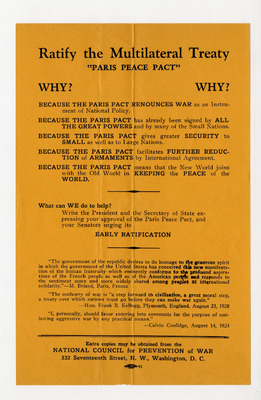
Ratify the Multilateral Treaty "Paris Peace Pact", 1928
National Council for Prevention of War (U.S.)
Pamphlet urging citizens to advocate for the United States Senate’s ratification of the 1928 Multilateral Treaty, commonly known as the Paris Peace Pact or Kellogg-Briand Pact. The document outlines key reasons to support the treaty and includes quotations from Aristide Briand, Frank B. Kellogg, and President Calvin Coolidge. The pamphlet encourages readers to write to the President, Secretary of State, and their Senators in support of early ratification.
-
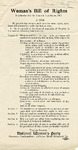
Woman's Bill of Rights: As Introduced in the Virginia Legislature, 1922
National Woman's Party
This pamphlet is a copy of the "Woman's Bill of Rights", a bill introduced by the National Woman's Party (NWP) to the Virginia General Assembly in 1922. The bill's objective was to provide women with the "same rights, privileges and immunities under the law, as men," specifically addressing issues like jury service, domicile, property rights, freedom of contract, and custody of children.
Learn more:
Women's Suffrage: The Movement, Social Welfare History Project
National Woman's Party, Social Welfare History Project -
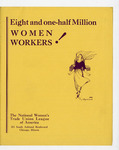
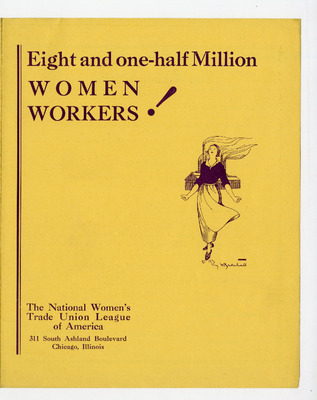
Eight and One-Half Million Women Workers!, 1917 May
National Women's Trade Union League of America
This pamphlet, published by the National Women's Trade Union League of America (NWTUL) around 1920, advocates for the organization and protection of the female industrial workforce. It uses statistics from the 1920 Census to highlight the "upheaval" in women's employment, noting that 8.5 million women were gainfully employed and detailing their increasing presence in manufacturing and mechanical industries. The pamphlet raises critical questions about women workers' pay, hours, and working conditions (such as seating, lighting, and sanitation), and proposes trade union organization as "A Way Out." Cover illustration of a young woman factory worker. Her apron and the smoke from factory smokestacks behind her are caught by the wind. Illustration by Winifred Bromhall, best known for her work as a children's book artist.
Excerpts:
p. 2 "According to the 1920 census, eight and one-half million women in the United States, 10 years of age and over, earn their own living and contribute to the support of others. This represents a half-million increase over 1910....One out of every 4 women wage-earners is in one of the manufacturing and mechanical industries."
p. 3 "A Way Out? Trade union organization--more and more of it--with its machinery for the collective merchandising of the day's work.
Voices here and there, raised in individual protest, are not heard above the din of the modern industrial machine. But the collective voice of millions of women who know for themselves the toll exacted for unnatural strain will compel a hearing for their industrial ills."
-
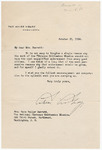
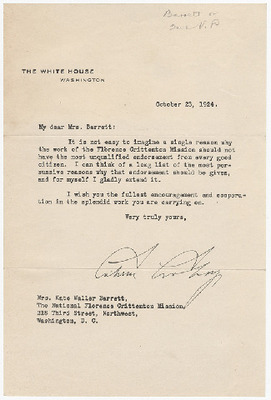
Letter from Calvin Coolidge to Kate Waller Barrett, 1924 October 23
Calvin Coolidge
Letter from President Calvin Coolidge to Kate Waller Barrett regarding the Florence Crittenton Mission which managed homes for unwed mothers and sex workers.
Learn more:
Kate Waller Barrett, Social Welfare History Project
Florence Crittenton Homes: A History, Social Welfare History Project
The Florence Crittenton Movement, Social Welfare History Project -
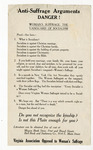
Anti-Suffrage Arguments: Danger!
Virginia Association Opposed to Woman's Suffrage
A single-sided handbill published by the Virginia Association Opposed to Woman's Suffrage. The handbill argues that woman suffrage will lead to socialism, the destruction of the Christian family, and an end to the holding of private property.
Learn more:
American Women Who Were Anti-Suffragettes. National Public Radio. -
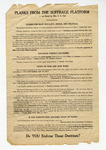
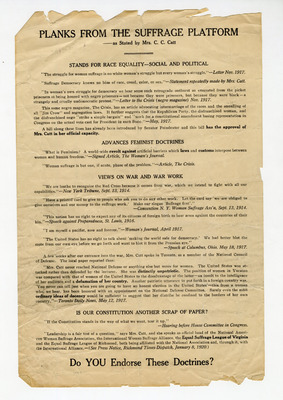
Planks from the Suffrage Platform
An anti-suffrage handbill which uses quotations from Carrie Chapman Catt to make its case that woman suffrage: supports racial equality, will lead to interracial marriage, will end to Jim Crow laws, advance feminist views, is unpatriotic, and does not support the war effort or the Constitution of the United States of America. The Equal Suffrage League of Virginia and the Equal Suffrage League of Richmond are both named. The writer of the handbill asks, "Is our Constitution another scrap of paper? Do YOU endorse these doctrines?"
-
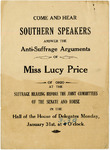
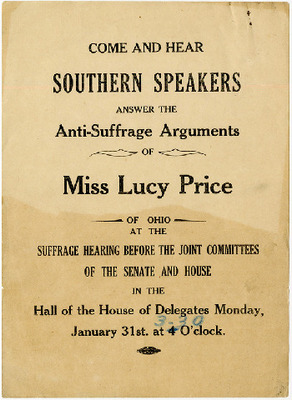
Come and Hear Southern Speakers Answer the Anti-Suffrage Arguments of Miss Lucy Price, 1915
Broadside advertising Southern speakers answering the anti-suffrage arguments of Miss Lucy Price of Ohio. Price was a well-known opponent of woman suffrage who argued "We know that we are the equals of men but we also feel that we have a work of our own that is just as important as that of men." (Cornell Daily Sun, 1915 February 12)
Learn more:
"Noted Anti-Suffragist to Speak Here Tonight. Miss Lucy Price Will Present Arguments Against Giving Ballot to Women." The Cornell Daily Sun, vol. 35, no. 101 (1915 February 12). Cornell University Library
Think Women Better Off Without Right to Vote" The Day (1913 February 21), p.11 -
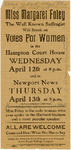
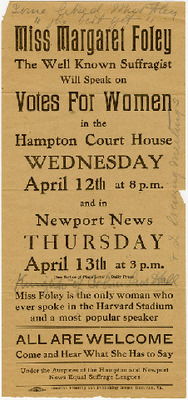
Miss Margaret Foley The Well Known Suffragist Will Speak on Votes For Women, 1916 April 12
Hampton and Newport News Equal Suffrage Leagues
Broadside publicizes two presentations by suffragist Margaret Foley: Hampton Court House on Wednesday, April 12, 1916 and in Newport News on Thursday, April 13, 1916.
Learn more:
Photograph of Margaret Foley distributing the Woman's Journal and Suffage News, Library of Congress
Papers of Margaret Foley, 1847-1968 (inclusive), 1909-1929 (bulk), Harvard Library
McDaid, J. D. (2019, September 12). Equal Suffrage League of Virginia (1909-1920), Encyclopedia Virginia -
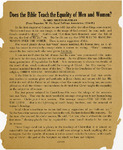
Does the Bible Teach the Equality of Men and Women? by Mrs. Milton McNeilan, 1915
Clarabel James McNeilan
This broadside is a theological defense of women's equality written by suffrage organizer Mrs. Milton McNeilan (Clarabel James McNeilan), a member of the Congressional Union for Woman Suffrage, and State Organizer of the West Virginia Equal Suffrage Association, 1914-15. The leaflet directly confronts anti-suffrage arguments that used biblical scripture, particularly the writings of St. Paul, to assert the subjection and inequality of women.
Excerpts:
"In the first chapter of Genesis we are told that after the other things were created “God created man in his own image, in the image of God created he him; male and female created he them.” And he said, “Let them dominion over the fish of the sea, the foul [sic] of the air, “ etc. But he did not say that ONE WAS TO HAVE DOMINION OVER THE OTHER. There is not a suggestion of this….“It was not until after the fall of man that the curse was pronounced the material curse for the man, bondage for the woman. …”
"In all Christ’s teachings we do not find even a suggestion of an “inferior sex....”
"Those who read the Bible intelligently, and understand the history of that period, will see that the place where it seems to teach the subjection and inequality of women, merely pertain to ancient Oriental customs and traditions, and are not the teachings of Christ. There is absolutely nothing in the latter to indicate that He would prohibit women from having a share in the government, merely because they are women. These accounts of ancient customs and traditions do not apply to women of today and more than they do to men of today, and have nothing to do with Christianity, as Christ taught it. If we are followers of Christ let us teach and quote Christ, who taught justice and equality for all, as well as an all embracing love, ‘love the fulfilling of the law.’ That is Christianity and what we should get from the Bible."
"(Reprinted from the Suffrage Edition of Atlantic City Review, October 12, 1915.)"
"Leaflets may be obtained from The Parkersburg Equal Suffrage Association at 5c per dozen."
"Printed in The City Print Shop, Parkersburg, by a Union Printer"
-
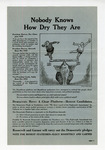
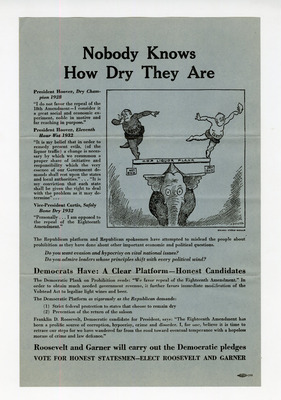
Nobody Knows How Dry They Are, 1932
This handbill advocates for the election of Democratic presidential candidate Franklin D. Roosevelt and his running mate John Nance Garner, and for the repeal of the Eighteenth Amendment. The handbill title calls to mind a popular refrain, "How Dry I Am."
An editorial cartoon by Guy Spencer (reprinted from the Omaha World Herald) points out that Republican Herbert Hoover and his running mate, Charles Curtis, hold opposing positions on the issue of repeal.
Excerpt:
"The Republican platform and Republican spokesmen have attempted to mislead the people about prohibition as they have done about other important economic and political questions.Do you want evasion and hypocrisy on vital national issues?
Do you admire leaders whose principles shift with every political wind?
Democrats Have: A Clear Platform--Honest Candidates
The Democratic Plank on Prohibition reads: 'We favor repeal of the Eighteenth Amendment.' In order to obtain much needed government revenue, it further favors immediate modification of the Volstead Act to legalize light wines and beer.
The Democratic Platform as vigorously as the Republican demands:
(1) Strict federal protection to states that choose to remain dry
(2) Prevention of the return of the saloon"Learn more:
Guy R. Spencer, 1878-1945. Finding Aid. Nebraska History Museum.
Flashback Friday Encore: Comics, Cartoons, Drawings and Doodles. Nebraska History.
Prohibition, Social Welfare History Image Portal -
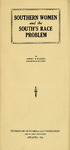
Southern Women and the South's Race Problem by Robert B. Eleazer
Robert B. Eleazer
Pamphlet published by the Commission on Interracial Cooperation, written by Robert B. Eleazer, Educational Director. The pamphlet describes commission meetings in Memphis, Tennessee and Atlanta, Georgia, and the responsibility felt by southern white women (primarily church women) to study and then improve the lives of Black women and children in their cities.
The need for day nurseries, kindergartens, clinics, playgrounds, better schools, improved housing and sanitation, safer conditions of travel, and especially the "unmeasured condemnation of lynching" are all noted.
p. 2 "The purpose of this organization and its affiliated state and local committees is to bring about better understanding, justice and fair dealing between the white and colored races. The Commission believes that the white race, as the more fortunate group and the one responsible for the Negro's presence in America, is under obligation to be both just and generous toward the latter. It believes further that the welfare and even the racial integrity of the two groups can be effectively preserved in no other way."
Learn more:
Pullen, Ann Ellis (2013). "Commission on Interracial Cooperation" New Georgia Encyclopedia.
Printing is not supported at the primary Gallery Thumbnail page. Please first navigate to a specific Image before printing.