













-

Marketing Principles From The River City
Jodie L. Ferguson, Jonathan Ross Gilbert, Katie Gilstrap, Suzanne C. Makarem, Mayoor Mohan, Butch M. Sarma, and Cesar Zamudio
Marketing Principles From the River City provides a contemporary exploration into the rudimentary concepts of marketing intended to be a free and open-access handbook for undergraduate introduction to marketing course students, a refresher resource for marketing majors entering upper level marketing courses, and a reference for marketing practitioners. Throughout the book, the reader will notice references to the hometown of Virginia Commonwealth University, Richmond, Virginia, also known as the “River City.” The book is divided into three overarching topic areas: Marketing and Markets, the Marketing Toolkit, and the Marketing Mix. Topics covered in the handbook include consumer and business-to-business behaviors, international marketing, strategic planning, marketing research, segmentation, targeting and positioning, product concepts, distribution, pricing, and promotion concepts.
-

Foundations of Business, 2nd Edition
Holly Jackson
Business Foundations was created for use in Virginia Commonwealth University’s BUSN 201: Foundations of Business. The course—and this text—introduces foundational concepts related to business environments, functions, and practices, while also emphasizing corporate social responsibility and ethical business behavior. By applying these concepts, students develop an integrated understanding of business and strengthen the analytical skills needed for advanced coursework and future careers.
-

Affordable Course Content Awards Authors Guide
Abbey Childs
This guide serves as a reference for faculty authors participating in the VCU Libraries Affordable Course Content Awards program.
-

Biological Basis of Behavior
Caroline O. Cobb
This text provides an overview of human behavior through a biological lens, with a focus on the central nervous system and its role in regulating and controlling behavior. Designed for graduate students in PSYC 629, it covers neuron structure and function, neurophysiology, basic neuroanatomy, drugs and behavior, internal regulatory processes, learning and memory, emotions, and selected forms of psychopathology.
The text also incorporates supplemental resources that situate these topics within their broader social context, including discussions of the historical harms experienced by minoritized populations from a behavioral neuroscience perspective.
-
Health Sciences Collection Development: An Overview of Fundamental Knowledge and Practices (2nd Edition)
Medical Library Association Collection Development Caucus, Karen H. Gau, and Iris Kovar-Gough
Last updated September 2024 / Originally submitted January 2023
This Open Access work from the Medical Library Association Collection Development Caucus provides an overview of the responsibilities and tasks involved in the development and management of health sciences collections. Readers can explore topics in greater detail through references at the end of each chapter. The second edition has a new section on unique collection genres; addresses Diversity, Equity, Inclusion and Accessibility in collections; incorporates significant updates to and expansion of previous content; and includes a glossary. Each chapter, as applicable, lists key communities and online courses for professional development on that topic.
Caucus members who served as primary content contributors are: Leah M. Anderson, MLS; Kristina DeShazo, MLS; Karen Gau, MLIS (co-editor); Iris Kovar-Gough, MA MLIS (co-editor); James Michael Lindsay, MSIS, MBA; Sarah McClung, MIS; Nicole Theis-Mahon, MLIS; Sarah Wade, MLS, AHIP; Erin Wentz, MSLIS; and Karen L. Yacobucci, MLS. A final draft was submitted to the caucus for review prior to publication.
This work was truly a collective effort, and we hope it gives readers an accessible entry point into the foundations of health sciences collection development.
-
Language and Culture in Context: A Primer on Intercultural Communication
Robert Godwin-Jones
For the classroom-friendly version of this book, please view the website version of this text of this text. This version is intended to serve as a preservation copy of the website.
This textbook on intercultural communication takes a collaborative and interdisciplinary approach: incorporating views and experiences from scholars and sources of diverse global backgrounds, integrating research findings from other disciplines, and developing a multicultural and multi-linguistic approach. -

Dermatologic Manifestations of Rheumatic Disease: Cutaneous Manifestations of Vasculitides
Julianna S. Kang, Julia Nunley, Tiffany Ho, Mavra Masood, Fnu Nutan, and Beth Rubinstein
This OER is a part of the Dermatologic Manifestations of Rheumatic Disease project, which provides overviews of the identification, diagnosis, and workup for different rheumatologic diseases, with a focus on providing examples from persons of color (POC). This work seeks to fill gaps and exclusionary practices in medical education practices and resources and diagnostic frameworks in regards to skin of color. This lack of representation bodes significant repercussions on the ability of future physicians to deliver equitable care for an increasingly diverse US population. Each module consists of a similar Powerpoint format, which includes key objectives, hypothetical disease cases, an overview of the pathophysiology, dermatologic features, and sequelae of these conditions, and clinical pearls regarding disease management.
Overall, the goal of this project is to provide a tailored resource for medical learners that addresses a longstanding educational deficit. The OERs will enable us to train future physicians who are not only clinically astute, but also knowledgeable of and sensitive to inequities in healthcare. Ultimately, it is our hope that these OER will aid in fostering a generation of physicians who are truly patient-advocates.
The following modules are included in the Dermatologic Manifestations of Rheumatic Disease project:
- Connective Tissue Disease
- Cutaneous Manifestations of Sarcoidosis
- Cutaneous Manifestations of Vasculitides
- Malignant Cutaneous Tumors
- Dermatoses of the Breast During Lactation
This module focuses on vasculitis. It will begin with the definition of terms and findings often found in vasculitis, followed by a review of several systemic vasculitides, highlighting how characteristic cutaneous lesions may be predictive of the vessel of involvement as well as the associated histologic changes. Moreover, significant clinical and laboratory findings utilized to make the correct diagnosis will be emphasized. This module is not meant to be an exhaustive review of vasculitis, but to serve as an introduction to understanding disease processes and how systemic vasculitis and skin findings interrelate.
Some images have been removed due to copyright restrictions. When available, the citation for the image was included. The module may be updated as openly licensed images illustrating the discussed topics become available
This module was created for use in the VCU School of Medicine M1 Movement block, Rheumatology and Dermatology sections.
-

L'Atelier RÉEL – Apprendre le français au niveau intermédiaire
Kathryn Murphy-Judy
This resource is a proficiency-framed, communicative, and task-based e-textbook for Intermediate French II.
Because learners at this level primarily communicate in sentence-level responses about routine, everyday situations, the four units of this e-textbook focus on strengthening skills across the three modes of communication—interpretive, interpersonal, and presentational—while deepening intercultural competencies. Unit themes include:
- presenting oneself and exploring bilingual, intersectional identity;
- engaging in written, oral, and mediated exchanges on topics of personal interest
- examining perspectives, products, and practices of francophone cultures and comparing them with one’s own; and
- mapping linguistic and cultural competencies onto students’ future personal and professional goals.
-

Introduction to Contemporary Mathematics Syllabus (Spring 2023)
Heather Nunnally
This syllabus was used in the Spring of 2023 for MATH 131: Introduction to Contemporary Mathematics. There were no textbook costs for this course; instead, MyOpenMath was used for the textbook and homework.
-
Dermatologic Manifestations of Rheumatic Disease: Malignant Cutaneous Tumors
Divya Shan, Julianna S. Kang, Allison Cinats, Julia R. Nunley, and Beth Rubinstein
This OER is a part of the Dermatologic Manifestations of Rheumatic Disease project, which provides overviews of the identification, diagnosis, and workup for different rheumatologic diseases, focusing on providing examples from persons of color (POC). This work seeks to fill gaps and exclusionary practices in medical education practices and resources and diagnostic frameworks in regards to the skin of color. This lack of representation bodes significant repercussions on the ability of future physicians to deliver equitable care for an increasingly diverse US population. Each module consists of a similar Powerpoint format, which includes key objectives, hypothetical disease cases, an overview of the pathophysiology, dermatologic features, and sequelae of these conditions, and clinical pearls regarding disease management.
Overall, the goal of this project is to provide a tailored resource for medical learners that addresses a longstanding educational deficit. The OERs will enable us to train future physicians who are not only clinically astute but also knowledgeable of and sensitive to inequities in healthcare. Ultimately, it is our hope that these OER will aid in fostering a generation of physicians who are truly patient-advocates.
The following modules are included in the Dermatologic Manifestations of Rheumatic Disease project:
- Connective Tissue Disease
- Cutaneous Manifestations of Sarcoidosis
- Cutaneous Manifestations of Vasculitides
- Malignant Cutaneous Tumors
- Dermatoses of the Breast During Lactation
This module focuses on Malignant Cutaneous Tumors. It begins with the definition of terms and findings, followed by a review of several clinical cases. The goal of the module is to provide the students with the ability to differentiate the most common types of skin cancer and precancerous lesions and gain an awareness of cutaneous lymphomas. This module will include images and clinical findings from diverse skin tones to prepare students to identify cutaneous findings in a heterogeneous patient population. This module is not a comprehensive review of skin cancers but an introduction to understanding how skin malignancies and physical exam findings interrelate.
This module is not a comprehensive review of skin cancers but rather an introduction to understanding how skin malignancies and physical exam findings interrelate.
Some images have been removed due to copyright restrictions. When available, the citation for the image was included. The module may be updated as openly licensed images illustrating the discussed topics become available.
This module was created for use in the VCU School of Medicine M1 Movement block, Rheumatology and Dermatology sections.
-
Dermatoses of the Breast During Lactation
Divya Shan, Sindhuja Koppu, Valerie Coleman, Gauri Gulati, and Kimberly Salkey
Dermatoses of the Breast during Lactation is a PowerPoint-based learning module that focuses on skin diseases of the breast and nipple that occur during lactation. It is a tailored resource for medical learners that provides an overview of the diagnosis, workup, and management of dermatoses of the breast that occur during breastfeeding, with a focus on providing examples in skin of color. The goal of this module is to provide students with the ability to differentiate the wide range of breast and nipple lesions that can arise during lactation and gain awareness of the skin conditions that present in breastfeeding individuals. The module presents differential diagnoses for breast dermatoses, followed by information on the clinical pearls, diagnostic tests, treatment, and management of these diseases. There is an additional self-assessment that can be taken before and after completing the module to help students reflect on their learning from this resource.
This module is not meant to be a complete review of breast dermatoses during lactation but rather an introduction to understanding how skin diseases and clinical findings interconnect for medical learners. It includes images and descriptions of clinical findings in different skin tones to prepare students to identify skin lesions in a diverse patient population. This module was created for use in the Virginia Commonwealth University School of Medicine Obstetrics and Gynecology Clerkship and has been implemented since April 2023.
The following modules are included in the Dermatologic Manifestations of Rheumatic Disease project:
- Connective Tissue Disease
- Cutaneous Manifestations of Sarcoidosis
- Cutaneous Manifestations of Vasculitides
- Malignant Cutaneous Tumors
- Dermatoses of the Breast During Lactation
Some images have been removed due to copyright restrictions. When available, the citation for the image was included. The module may be updated as openly licensed images illustrating the discussed topics become available.
-
Dermatologic Manifestations of Rheumatic Disease: Connective Tissue Disease
Mavra Masood, Beth Rubinstein, Julia Nunley, Fnu Nutan, Yasmin John, and Haseeb Mahmud
This OER is a part of the Dermatologic Manifestations of Rheumatic Disease project, which provides overviews of the identification, diagnosis, and workup for different rheumatologic diseases, with a focus on providing examples from persons of color (POC). This work seeks to fill gaps and exclusionary practices in medical education practices and resources and diagnostic frameworks in regards to skin of color. This lack of representation bodes significant repercussions on the ability of future physicians to deliver equitable care for an increasingly diverse US population. Each module consists of a similar Powerpoint format, which includes key objectives, hypothetical disease cases, an overview of the pathophysiology, dermatologic features, and sequelae of these conditions, and clinical pearls regarding disease management.
Overall, the goal of this project is to provide a tailored resource for medical learners that addresses a longstanding educational deficit. The OERs will enable us to train future physicians who are not only clinically astute, but also knowledgeable of and sensitive to inequities in healthcare. Ultimately, it is our hope that these OER will aid in fostering a generation of physicians who are truly patient-advocates.
The following modules are included in the Dermatologic Manifestations of Rheumatic Disease project:
- Connective Tissue Disease
- Cutaneous Manifestations of Sarcoidosis
- Cutaneous Manifestations of Vasculitides
- Malignant Cutaneous Tumors
- Dermatoses of the Breast During Lactation
This module on Connective Tissue Disease goes over findings in systemic lupus erythematosus, dermatomyositis, and systemic sclerosis. Included in this module is a slide deck filled with information for a lecture or self study, a practice test, a glossary of terms, as well as a summary of notes for quick studying. It takes approximately 25 minutes to complete.
Some images have been removed due to copyright restrictions. When available, the citation for the image was included. The module may be updated as openly licensed images illustrating the discussed topics become available. Students are welcome to find images on VisualDx, the American College of Rheuematology Image bank, and the University of New Mexico Image Bank.
This module was created for use in the VCU School of Medicine M1 Movement block, Rheumatology and Dermatology sections.
-

Taller REAL
Laura Middlebrooks
The Taller REAL (Recursos Educativos Abiertos y Libres) BETA was created for use in Virginia Commonwealth University's fourth semester Spanish course, SPAN 202, in which students study inclusivity (la inclusividad), health and wellbeing (la salud y el bienestar), career paths and professionalism (las carreras y el profesionalismo) as well as current events (las noticias).
-

Dermatologic Manifestations of Rheumatic Disease: Cutaneous Manifestations of Sarcoidosis
Sarah Shapiro, Sindhuja Koppu, Mavra Masood, Beth Rubinstein, and Huzaefah Syed
This OER is a part of the Dermatologic Manifestations of Rheumatic Disease project, which provides overviews of the identification, diagnosis, and workup for different rheumatologic diseases, with a focus on providing examples from persons of color (POC). This work seeks to fill gaps and exclusionary practices in medical education practices and resources and diagnostic frameworks in regards to skin of color. This lack of representation bodes significant repercussions on the ability of future physicians to deliver equitable care for an increasingly diverse US population. Each module consists of a similar Powerpoint format, which includes key objectives, hypothetical disease cases, an overview of the pathophysiology, dermatologic features, and sequelae of these conditions, and clinical pearls regarding disease management.
Overall, the goal of this project is to provide a tailored resource for medical learners that addresses a longstanding educational deficit. The OERs will enable us to train future physicians who are not only clinically astute, but also knowledgeable of and sensitive to inequities in healthcare. Ultimately, it is our hope that these OER will aid in fostering a generation of physicians who are truly patient-advocates.
The following modules are included in the Dermatologic Manifestations of Rheumatic Disease project:
- Connective Tissue Disease
- Cutaneous Manifestations of Sarcoidosis
- Cutaneous Manifestations of Vasculitides
- Malignant Cutaneous Tumors
- Dermatoses of the Breast During Lactation
This module focuses on sarcoidosis. It begins with a fictional patient presenting with lupus pernio, which serves as an introduction to the dermatologic features of sarcoidosis. The module then delves further into the other cutaneous and non-cutaneous manifestations, diagnostic criteria, and medical evaluation of sarcoidosis. Health and racial disparities experienced by patients with sarcoidosis are also highlighted and discussed. The second half of the module follows a fictional patient presenting with erythema nodosum, a common but non-specific cutaneous finding in sarcoidosis. The module then delineates the possible etiologies, workup, treatment, and prognosis of erythema nodosum. It takes approximately 25 minutes to complete.
Some images have been removed due to copyright restrictions. When available, the citation for the image was included. The module may be updated as openly licensed images illustrating the discussed topics become available
This module was created for use in the VCU School of Medicine M1 Movement block, Rheumatology and Dermatology sections.
-
Foundations of Business
Manika Avasthi
Foundations of Business was created for use in Virginia Commonwealth University BUSN 201. In this course, students will study the concepts, principles and operations of private enterprise. They will compare and contrast sole proprietorships, partnerships, and corporations – and the advantages and disadvantages of each. Students will explore the functions of modern business management, marketing, and ethics and social responsibility that can improve or tarnish a brand. They will also look at the human resource management side of running a business and learn how employers can motivate their employees. Finally, students will address the numbers side of running a business and examine bookkeeping, accounting, financial management, and financial statements.
The work is a remix/adaption of:
- “Fundamentals of Business, Second Edition (2018)” by Stephen J. Skripak (VT Publishing), licensed under CC BY-NC-SA 4.0
- “Introduction to Business” by Lawrence J. Gitman, et al (OpenStax), licensed under CC BY 4.0
- “Exploring Business “, University of Minnesota is licensed under CC BY-NC-SA 4.0
Please view the acknowledgments for more information about how these 3 OERs have been used. Chapter 16 includes original content provided by VCU School of Business Career Services.
-

Digital Histology
John W. Bigbee
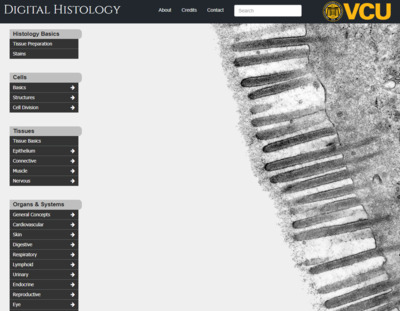
Digital Histology is an interactive, online, openly licensed histology text and atlas that presents all the topics covered in professional, graduate, and undergraduate histology courses. It offers many unique and distinctive features beyond statically-labeled atlases, including:
- On-demand, dynamic labeling.
- Menu-driven navigation that reinforces broader concepts in histology.
- Descriptive introductory text for each image as well additional descriptions for labeled structures.
- Chapter and section overviews including over 75 original diagrams.
- Over 1000 high quality, high resolution histological images.
- Interactive quizzes with feedback.
- An outline-style review text that contains hyperlinks to images in the main program.
- Randomization of images, including hiding of labels for an additional self-assessment mode.
- Ability to include hyperlinks to virtual microscopy slides.
- Cross-platform compatibility across devices and screen sizes.
Learn more by watching this introductory video.
The full project team was:
- John Bigbee, Ph.D. and Alice S. Pakurar, Ph.D. (Coauthors)
- Kenneth Warren Foster, Ed.D. and Thomas W. Woodward, MS (Design Coordinators)
- Carole W. Christman, Ph.D. (Medical Illustrator)
- Department of Anatomy and Neurobiology
- Office of Faculty Affairs, VCU School of Medicine
- ALT Lab of VCU
-
Structuring Online Lectures
Hope Y. Kelly
A slide deck that examines what online lectures and lessons are, provides a planning template for developing a structured online lecture with a variety of interactions. These interaction ideas are also highlighted in a tools & methods document, and an example planning document is also presented.
-
Gender Identity and Gender Inclusivity: Lesson Plan for Virginia and U.S. Government
Kristina Lee
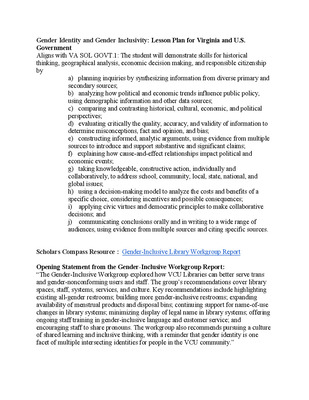
Lesson plan for use with the document Gender-Inclusive Library Workgroup Report. Designed to promote high school level discussion around gender-neutral spaces and policies. Aligns with VA SOL GOVT.1. Includes opening activity for students, articles for discussion, and project outline.
-
The History of Monuments and the Opportunity to Reimagine Them: A Lesson Plan for Virginia and U.S. Government
Kristina Lee
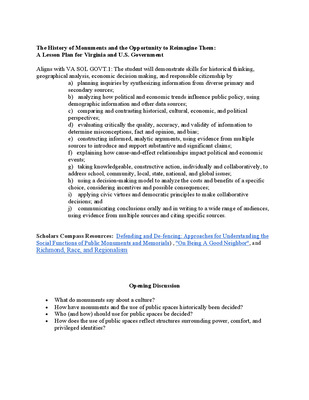
This lesson plan was developed for a VCU School of Education doctoral externship. It is designed to foster discussion at the high school level about the purpose of monuments and the possibilities for their repurposing or reimagining. The lesson draws on an article from the Journal of Social Theory in Art Education, a VCU MFA thesis on the design of a slavery museum, and videos from the Richmond Peace Education Center.
The plan aligns with VA SOL GOVT.1 and includes opening discussion questions, a group project for students, and selected readings for class discussion.
-

Research Methods in Sport Syllabus (Fall 2019)
Gregory Greenhalgh
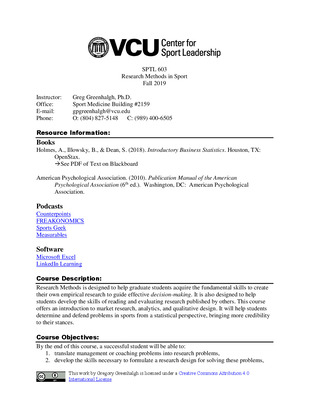
This syllabus outlines the first semester of SPTL 603: Research Methods in Sport. The course schedule details the required readings, podcasts, and a LinkedIn Learning course.
-

Sports Business Course Outline (Fall 2018)
Brendan Dwyer
This syllabus outlines the fall 2018 semester of SPTL 632: Sport Business.
-

VCU Writes: A VCU Student's Guide to Research and Writing
Focused Inquiry Textbook Committee
VCU Writes! provides materials to enhance academic research, writing, and learning experiences. The site includes a detailed citation manual for both APA and MLA styles, which is updated whenever a new version of each style guide is released, and reading lists to help learners build skills in topics such as critical thinking, ethical reasoning, and writing & argument. Examples of student work are provided and continually updated. The resource was created for use in VCU's Focused Inquiry department, specifically Focused Inquiry I and II (UNIV 111 and 112); Inquiry and the Craft of Argument (UNIV 200). The Focused Inquiry Textbook Committee created and updates the work.
Printing is not supported at the primary Gallery Thumbnail page. Please first navigate to a specific Image before printing.