



Files
Download Full Text (680 KB)
Abstract
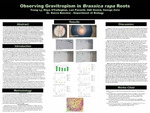
The objective of this experiment is to observe the effect of gravitropism on the orientation of Brassica rapa (B. rapa) roots. Specifically, amyloplasts that reside at the bottom of root tips act as gravity sensors. As plants are disturbed from upright orientation, roots automatically grow according to the downward pull of gravity. It is hypothesized that as the angle of rotation increases, the angle of root growth is inversely proportional. Five plants containing four seeds of B. rapa were grown over the course of 10 days. Each plates, aside from the control, were rotated once 90°, 80°, and 270° to the horizontal axis. Additionally, one plate contained salted agar at the bottom third to observe the effect of halotropism on root growth. It is hypothesized that as roots approach high salt concentration, they will respond by growing away. Similar to the control, the salted agar plate was kept at 0°. After 10 days, it was observed that the root angle for the 180" rotation was significantly different from the control. The 90° and 270° rotation values differ, but they are within standard ranges of each other. The results showed that the root angle changes in response to increasing plate angle, but they only weakly support the hypothesis that as the angle of rotation of the plates is increased, the root angle inversely decreases.
Publication Date
2022
Subject Major(s)
Biology
Keywords
Plants, Botany, Plant science
Current Academic Year
Junior
Faculty Advisor/Mentor
Sierra Beecher
Sponsorship or Grant Funding
Virginia Commonwealth University. Undergraduate Research Opportunities Program
Rights
© The Author(s)
Disciplines
Agriculture | Biology | Botany
Is Part Of
VCU Undergraduate Research Posters
Downloaded from
Ly, Trang; O'Callagham, Maya; Poeschl, Lan; Saeed, Adil; and Zorn, George, "Observing Gravitropism in Brassica rapa Roots" (2022). UROP Posters. Poster 462.
https://scholarscompass.vcu.edu/uresposters/462