



Extrusion-based Additive Manufacturing of Magnetic Heat Exchange Structures for Caloric Applications
Files
Download Full Text (1.3 MB)
Abstract
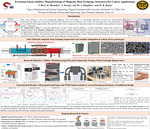
Developing sustainable, high-efficiency cooling technologies is vital to addressing 21st century energy challenges. This research focuses on magnetic refrigeration, an environmentally friendly cooling method utilizing the magnetocaloric effect to regulate temperature using magnetic fields. This approach offers greater energy efficiency than conventional vapor-compression systems by eliminating harmful refrigerants. The critical component is the regenerator, made of magnetocaloric material and transfers heat between the magnetic material and a fluid through parallel channels. Traditional designs such as packed beds of particles are prone to particle segregation, creating an undesirable pressure drop. The main goal of our research was to fix those flaws by building brand new heat exchanger structures that we could easily install and test inside a working prototype magnetic cooling machine. Our methodology involved utilizing Additive Manufacturing (AM), specifically Laser Powder Bed Fusion (L-PBF), to produce complex and customized geometries that are difficult to create with traditional methods. We tested several advanced designs, including Schwarz diamond, Gyroid lattices, and foil pin arrays. These AM regenerators were tested in a CaloriSMART test bed for experimental validation of their thermal performance. The experiments were conducted without an applied magnetic field to isolate structural effects and yielded compelling results. The foil pin array achieved a 10°C temperature span, a 66% increase over the 6°C span of the packed particle bed baseline. Both the foil pin and Schwarz diamond structures demonstrated an 8% increase in cold blow effectiveness. Furthermore, the AM designs significantly reduced pressure losses. At a mass flow rate of 0.00299 kg/s, the foil pin array reduced the pressure drop by 41.9% compared to the packed bed baseline (24.70 kPa vs. 42.55 kPa). Ongoing research aims to democratize access to this technology through exploring Fused Filament Fabrication (FFF) as a portable and low-cost alternative to L-PBF.
Publication Date
2026
Subject Major(s)
Mechanical Engineering
Keywords
Addictive Manufacturing, Magnetic Heat Exchange, MagnetoCaloric, CaloriSMART
Disciplines
Materials Science and Engineering | Mechanical Engineering
Current Academic Year
Junior
Faculty Advisor/Mentor
Dr. Radhika Barua
Rights
© The Author(s)