



Files
Download Full Text (522 KB)
Abstract
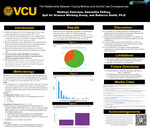
The purpose of this study was to examine the difference in alcohol use consequences between those who drink to cope with anxiety or depression symptoms and those who do not. Our research aimed to expand on earlier studies by placing emphasis on how coping with anxiety and depression influences alcohol consequences using constructs aligned with DSM-V symptom criteria. Research has consistently shown that those who drink to regulate distressing emotions experience more harmful consequences, making this an imperative area for prevention efforts. It was hypothesized that coping motivated drinking would be associated with an increased amount of alcohol related consequences. Participants were college students who participated in a Spit for Science study (n = 457). Spit for Science is a research initiative that aims to understand the biological and environmental underpinnings for substance use and mental health in college aged students. Those who participated completed a self-report measure evaluating drinking motives and alcohol consequences. We conducted an Independent Samples T-Test using our measures to evaluate drinking motives and alcohol consequences. Results show there is a significant difference in alcohol use consequences between those who drink to cope (M=1.77, SD=2.25) and those who did not drink to cope (M=0.8294, SD=1.42), t(338)= -4.777, p< 0.001. These results support the current research literature indicating that coping motivated drinking can result in more consequences. Other studies suggest that by developing positive coping strategies this not only decreases anxiety and depressive symptoms, but also decreases alcohol consequences. Therefore, highlighting the importance of teaching healthy coping skills and alternative coping mechanisms as an intervention strategy for risky alcohol consumption. Implementing new program approaches that teach students emotional regulating skills, stress management and positive coping strategies offer promising ways to reduce risky alcohol use.
Publication Date
2026
Subject Major(s)
Psychology
Keywords
substance use, alcohol, college, coping, depression, anxiety
Disciplines
Clinical Psychology
Current Academic Year
Junior
Faculty Advisor/Mentor
Rebecca Smith
Faculty Advisor/Mentor
Amy Atkins
Rights
© The Author(s)
Recommended Citation
Feliciano, M., Pelfrey, S., & Smith, R. (2026). The Effects of Coping Motives on Alcohol Use Consequences [Poster]. Department of Psychology, Spit for Science Working Group, Virginia Commonwealth University.