



Files
Download Full Text (2.1 MB)
Abstract
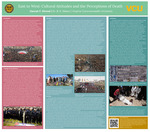
Death is a universal human experience, but cultures teach people to interpret it in different ways. These interpretations influence how individuals understand dying, how they cope with loss, what support looks like, and what meaning death makes in their lives. Eastern, spiritual, and religious traditions emphasize death as a natural transition or return to divinity rather than an endpoint, and as something one must prepare for. In these contexts, people often grow up hearing stories, prayers, and teachings that situate death within a broader journey. Because of this, death becomes something familiar and speakable rather than distant or frightening (Naderi-Afif 2023) and it incites unity and communal mobilization. Furthermore, the remembrance of death is seen as a motivator for moral actions during life. In contrast, many Western societies display a more private, medicalized, and emotionally restrained approach to death (Ariés 1974). Secularization leads to an approach to living that is based in egocentrism rather than objective morality, removing the relevance of death until it occurs. Furthermore, the avoidant attitude towards death in Western societies creates distance between life and mortality, leaving people without the tools to process grief. This leads to isolation in communities and individual mental health struggles. This project compares the differing orientations toward death to highlight how cultural beliefs, spirituality, language, and community influence the emotional and social experience of mortality, and the ramifications of this on social justice movements and global phenomena.
Publication Date
2026
Subject Major(s)
Anthropology
Keywords
Death and dying, cultural linguistics, religion, spirituality, martyrdom, grief
Disciplines
Anthropological Linguistics and Sociolinguistics | Anthropology | Comparative Methodologies and Theories | International and Area Studies | Islamic Studies | Multicultural Psychology | Politics and Social Change | Regional Sociology | Religion | Social and Cultural Anthropology
Faculty Advisor/Mentor
Bernard K. Means
Rights
© The Author(s)
Included in
Anthropological Linguistics and Sociolinguistics Commons, Comparative Methodologies and Theories Commons, International and Area Studies Commons, Islamic Studies Commons, Multicultural Psychology Commons, Politics and Social Change Commons, Regional Sociology Commons, Social and Cultural Anthropology Commons