



Files
Download Full Text (406 KB)
Abstract
ABSTRACT
Background: Mental illness affects 1-in-5 adults in the United States (US). Previously, those with mental illness have been shown to be 70% more likely to smoke cigarettes than the general population. However, little is known regarding whether the use of menthol cigarettes (one of only two available “characterizing flavors” of cigarettes) might impact the association between tobacco use and mental illness. Such information is critical in light of the disproportionately high rate of use of menthol cigarettes observed among African American smokers, as well as to inform recent legislative proposals that seek to ban the sale of menthol cigarettes.
Objective: This work sought to characterize the association between menthol cigarette use and Any Mental Illness (AMI) and/or Serious Mental Illness (SMI) among smokers, as well as to determine if this association differed by race-ethnicity.
Method: Data from the 2012-2018 National Survey on Drug Use and Health (NSDUH) were used. Analyses were restricted to those observations that were aged 18-64 at the time of survey administration, that had smoked cigarettes in the past-30 days, and that had smoked at least 100 cigarettes in their lifetime. The analytic sample (n=61,250) was weighted to account for complex survey design using the Taylor Series Linearization method and represented an estimated 42,649,828 individuals. Respondents were classified as “menthol smokers” if they reported that the cigarettes they used most often in the last 30 days were mentholated. Presence of both AMI and SMI were determined using a NSDUH defined algorithm that incorporates responses from the Kessler-6 psychological distress scale (K6) and the World Health Organization Disability Assessment Schedule (WHODAS). Logistic regressions characterized the adjusted association between menthol cigarette use and AMI/SMI. Adjusted regression were then repeated, but stratified by race-ethnicity.
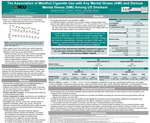
Results: Menthol smokers were more likely to have AMI (aOR=1.123, 95% Confidence Interval:[1.062-1.189]) than non-menthol smokers but not SMI (aOR=1.067 [0.969-1.175]). Non-Hispanic White (NH-W) menthol smokers were at higher risk for both AMI (aOR=1.146 [1.067-1.230]) and SMI (aOR=1.127 [1.014-1.252]) than NH-W non-menthol smokers. Hispanic menthol smokers were found to have higher odds of AMI (aOR=1.294, [1.088-1.538]), but not SMI (aOR=0.993 [0.730-1.352]), than Hispanic non-menthol smokers. Notably though, non-Hispanic African American/Black (NH-AA) menthol smokers were found to have lower adjusted odds of both AMI (aOR=0.711 [0.551-0.918]) and SMI (aOR=0.577 [0.377-0.882]) than NH-AA non-menthol smokers.
Conclusion: This work supports the idea that while menthol cigarette use may be associated with higher incidence of mental illness among smokers, this association is not consistent across racial-ethnic groups. These results underscore the importance of characterizing the social and cultural factors that may influence mental health and tobacco use.
Publication Date
2021
Keywords
Menthol, mental illness, tobacco
Disciplines
Behavior and Behavior Mechanisms | Mental Disorders
Faculty Advisor/Mentor
Andrew Barnes
Is Part Of
VCU Graduate Research Posters