



Files
Download Full Text (1.4 MB)
Abstract
High-speed, low-latency internet connectivity on the move is a critical challenge for applications in connected vehicles, disaster response, and remote education. While terrestrial networks such as 4G or 5G are widespread, they lack coverage in remote or rural geographic areas.
Low Earth Orbit (LEO) satellite constellations, such as SpaceX's Starlink, promise global high-bandwidth, low-latency internet. However, their performance is well-documented in stationary scenarios, while data for *mobile* applications is scarce. This project explores the feasibility and real-world performance of LEO satellite internet while in motion.
Current research documents the performance of LEO satellite constellations in stationary settings. However, data concerning mobile performance remains scarce. Furthermore, prior studies suggest that Starlink’s global scheduler reallocates satellites roughly every 15 seconds. This project attempts to make a unique contribution by verifying these scheduling behaviors in a mobile environment and determining if the 15-second reassignment cycle impacts connectivity stability while the user is in transit.
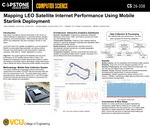
To capture real-world data, the team designed and deployed a mobile measurement system by mounting the Starlink satellite on a vehicle. This system captured precise GPS data simultaneously with connectivity metrics, including upload/download speeds and latency. First, throughput was tested on standard Wi-Fi and 5G mobile hotspots using iperf3 to establish a control group. A Python script using Dash was developed to render collected data as geographic heatmaps, facilitating the identification of spatial performance patterns. A replication experiment was conducted by issuing Round-Trip Time (RTT) measurements every two seconds to test the reported 15-second satellite reallocation boundary.
Along with testing the reported 15-second satellite reallocation boundary, a key end goal of the project is to compare critical connectivity metrics between traditional wireless phone services and Starlink’s satellite connectivity. As of now, data on T-Mobile, Verizon, and AT&T are being collected in tandem with Starlink data to help determine the feasibility of Starlink over a traditional mobile data plan. Data collection will be expanded to record weather, speed of travel, and location type, such as urban or rural. At the project's conclusion, we hope to have a clear picture of the advantages and disadvantages of Starlink and in what context it is best applied.
Publication Date
2026
Subject Major(s)
Computer Science
Keywords
Starlink, internet, data, software
Disciplines
Aerospace Engineering | Computational Engineering | Computer Engineering
Current Academic Year
Senior
Faculty Advisor/Mentor
Eyuphan Bulut
Rights
© The Author(s)
Included in
Aerospace Engineering Commons, Computational Engineering Commons, Computer Engineering Commons