



Files
Download Full Text (3.9 MB)
Abstract
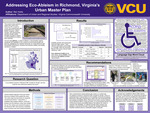
As Richmond, Virginia, approaches its 300th anniversary in 2037 and continues implementing Richmond 300: A Guide for Growth, questions remain about whether individuals with disabilities are equitably represented in the city’s future planning. Richmond 300 is the comprehensive plan guiding Richmond’s policies, programs, zoning changes, and redevelopment. This master plan is a “living document” that will evolve as the city grows, meaning revisions and improvements are possible before its full implementation. This study asks: Is eco-ableism present in Richmond 300: A Guide for Growth, and how could the City of Richmond address this issue?
Ableism refers to discrimination against individuals with disabilities, whether explicit, such as denying equal employment, or implicit, such as the absence of ramps, sensory supports, or accessible pathways. The term eco-ableism expands this idea to environmental design and planning, highlighting how disabled individuals are marginalized through inaccessible infrastructure, exclusion from decision-making, and limiting narratives or beliefs. This builds on the planning concept of “spatializing disability,” or analyzing how people with physical or cognitive differences navigate spaces shaped by historical and structural forces.
This study conducts a master-plan review of Richmond 300, focusing on disability inclusion with respect to vision, sensory, and ambulatory disabilities as defined by the U.S. Census Bureau. Using Critical Discourse Analysis (CDA), the plan will be examined for embedded power structures, whose voices are included or omitted, and whether accessibility is meaningfully prioritized. A Textual Analysis Approach (TAA) will guide coding for keywords, themes, and discourse patterns related to eco-ableism. The hypothesis is that Richmond 300: A Guide for Growth includes approved accessibility measures that equitably address the needs of disabled residents. This research aims to identify existing strengths and gaps to support more inclusive future planning.
Publication Date
2026
Subject Major(s)
Urban and Regional Studies
Keywords
ableism, eco-ableism, disabilities, “Richmond, Virginia”, “urban planning”, “urban green spaces”, “green spaces”, “green infrastructure”, “planning processes”, “equitable inclusion”, accessibility
Disciplines
Disability Studies | Environmental Studies | Urban Studies and Planning
Current Academic Year
Senior
Faculty Advisor/Mentor
Shruti Syal
Rights
© The Author(s)
Recommended Citation
Hollis, R. (2026, March). Addressing eco-ableism in Richmond, Virginia’s urban master plan [Research poster]. Virginia Commonwealth University.
Included in
Disability Studies Commons, Environmental Studies Commons, Urban Studies and Planning Commons