



Files
Download Full Text (5.8 MB)
Abstract
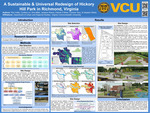
Urban green spaces provide essential environmental, psychological, and physical benefits, yet access to these resources is often inequitable. Cities are increasingly vulnerable to climate change, highlighting the need for adaptive design. This study focuses on the redesign of Hickory Hill Park in Southside Richmond, selected through a combination of site suitability analysis and qualitative survey. The guiding research question is: How can a park in Richmond be designed to optimize environmental resilience, accessibility, and community benefits?
The selection of a research location and scope used a mixed-methods approach integrating spatial analysis, environmental assessment, and community engagement. A site suitability analysis was conducted using a combination of an Analytic Hierarchy Process, SVI scores, and accessibility factors on potential parcels. Equity criteria were incorporated through spatial and social equity modeling. A qualitative onsite tour identified Hickory Hill Park as the primary research location based on its open space, neighborhood characteristics, and potential for development. Community perspectives were collected through a combination of written surveys and interviews with residents and community center staff, both on-site and within the neighborhood.
The resulting redesign integrates community-identified needs with universal design and climate-resilient features. Guided by the American Society of Landscape Architects, UCLA’s Guidelines for Senior-Friendly Parks, and ADA regulations, the design supports people of all ages and abilities. Features include an amphitheater for public gatherings, an accessible main entrance, an intergenerational playground and quiet area, improved transit amenities, and inclusive recreation spaces. Green infrastructure, pervious surfaces, rain gardens, expanded vegetation, solar lighting, and heat-reducing materials strengthen stormwater management and mitigate urban heat island effects.
Expected results suggest a redesigned Hickory Hill Park would improve environmental performance, increase accessibility, and address underrepresented community needs. This project provides a model for how community-driven, equity-centered park redesign can support long-term sustainability and public well-being in urban contexts.
Publication Date
2026
Subject Major(s)
Urban and Regional Studies
Keywords
parks, "climate change mitigation", "universal design", sustainability, "green spaces", "mixed-methods approach", "Analytic Hierarchy Process", "community engagement", "Richmond, Virginia"
Disciplines
Disability Studies | Human Geography | Natural Resources and Conservation | Spatial Science | Sustainability | Urban Studies and Planning
Current Academic Year
Senior
Faculty Advisor/Mentor
Shruti Syal
Rights
© The Author(s)
Recommended Citation
Hollis, R., Lin, C., Miller, K., Nivera, J., O’Shea, P., Tsou, C., & Wines, H. (2026, March). A sustainable & universal redesign of Hickory Hill Park in Richmond, Virginia [Research poster]. Virginia Commonwealth University.
Included in
Disability Studies Commons, Human Geography Commons, Natural Resources and Conservation Commons, Spatial Science Commons, Sustainability Commons, Urban Studies and Planning Commons