



Files
Download Full Text (2.5 MB)
Abstract
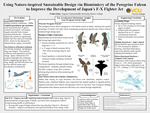
Modern fighter jets face a persistent challenge when it comes to improving aerodynamic efficiency without having to sacrifice high-speed performance or long-term sustainability. These aircraft rely heavily on high thrust and agility, and in doing so, they consume substantial amounts of fuel due to aerodynamic drag and limited energy efficiency. As a result of these constraints, advanced military defense development projects, such as Japan’s Mitsubishi F-X fighter jet program, have been delayed. This highlights the need for more sustainable solutions. Biologically inspired design, or biomimicry, has emerged as a potential and promising alternative. The peregrine falcon, notably the fastest bird in the world, exhibits extraordinary flight capabilities that include steep dives that exceed 320 km/h, precise maneuvering, and stability under harsh conditions. In this paper, a comprehensive literature review was conducted to explore how the peregrine falcon could inform next-generation fighter jet design and aerodynamics. By using a comparative analysis of both biological and engineering studies, this paper investigated the four key aspects of the falcon’s morphology, which include tapered wing structures, micro structured feathers, joint flexibility, and dynamic tail control. This paper ultimately examines how these traits can be applied to aircraft systems. The findings suggested that these natural mechanisms exhibited by the peregrine falcon (Falcon peregrinus) may parallel emerging morphing-wing technologies that are aimed towards enhancing lift-to-drag ratios and conserving fuel. Incorporating these biomimetic adaptations into aircraft systems, such as the Mitsubishi F-X, could significantly reduce operational energy demands, improve fuel efficiency, and enhance maneuverability and stability at high speeds.
Publication Date
2026
Subject Major(s)
Mechanical and Aerospace Engineering
Disciplines
Aerodynamics and Fluid Mechanics | Systems Engineering and Multidisciplinary Design Optimization
Current Academic Year
Freshman
Faculty Advisor/Mentor
Mary Boyes
Rights
© The Author(s)
Included in
Aerodynamics and Fluid Mechanics Commons, Systems Engineering and Multidisciplinary Design Optimization Commons