



Files
Download Full Text (763 KB)
Abstract
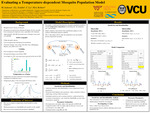
Dengue Virus causes over 390 million infections and around 40,000 deaths each year. This virus is primarily transmitted by the mosquito Aedes aegypti. The life cycle of these mosquitos is significantly impacted by temperature, however, temperature is often neglected in mechanistic models. Predictive models of mosquito populations thus require the inclusion of temperature and are valuable for helping medical officials plan for the impact of outbreaks. Using mosquito and climate data collected in Córdoba, Argentina from 2010-2013, we developed a non-autonomous ordinary differential equations model that includes temperature dependent parameters associated with mosquito life history. We performed local sensitivity and identifiability analysis to determine which model parameters should be estimated. We explored the effects of incorporating temperature in different combinations of life history characteristics to find the most parsimonious model that includes temperature. Additionally, we estimated values for combinations of density-dependent parameters to improve the model fit. These parameters control nonlinear population regulation but are often difficult to estimate from data alone. We found that including even just three temperature-based parameters: eggs laid per adult female, development rate of juveniles to adults, and adult mortality rate, produced a model that matches the data well. Additionally, we fit a density-dependent parameter and combinations of density dependent parameters to improve the model fit. We discuss these results in the context of improving mosquito population and dengue epidemiological models.
Publication Date
2023
Keywords
dengue, population modeling
Disciplines
Applied Mathematics
Faculty Advisor/Mentor
Michael Robert
Is Part Of
VCU Graduate Research Posters